Three Points to Remember from the Cuban People
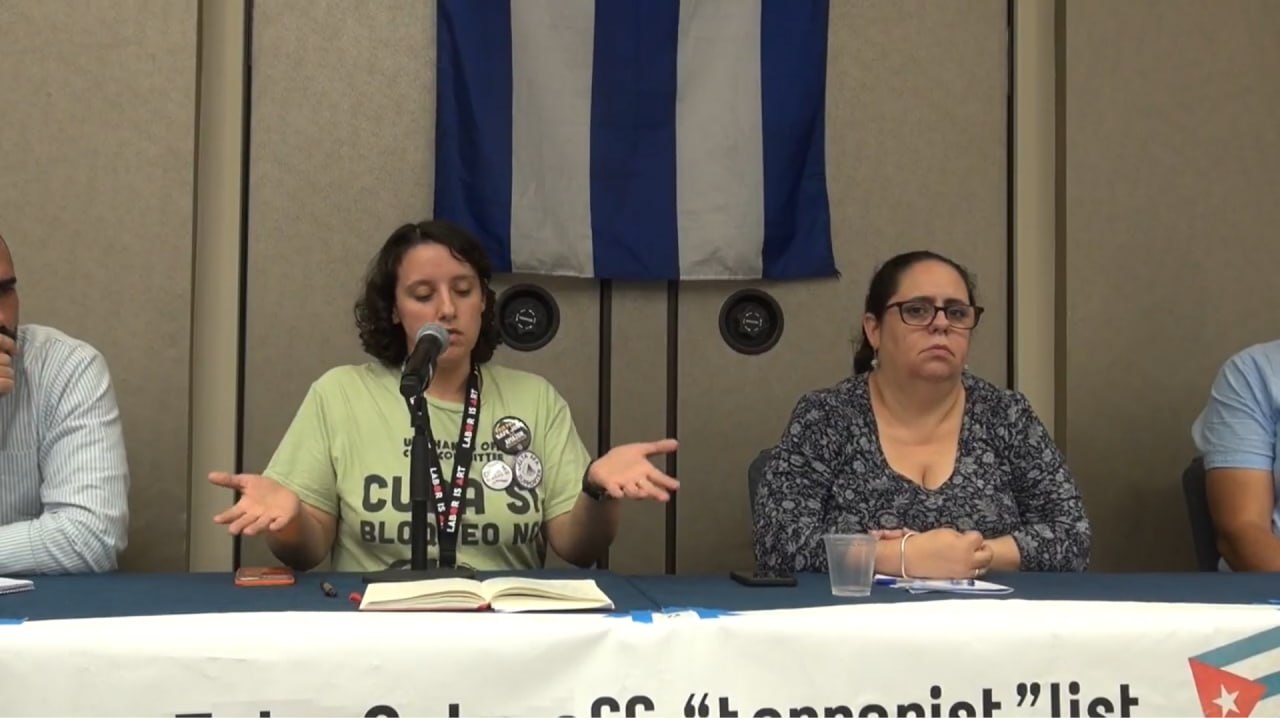
Amber Longo not only took part in the historic May Day event but also joined an internship with the Workers Central Union of Cuba (CTC). She highlighted three main takeaways that the Cuban people wanted to share with her and the world.
Point 1 – Education
During the internship, Londo took part in roleplaying exercises that she found valuable. “The instructors would put us in these sophisticated role-playing sessions for workplace scenarios. They would give us roles with different individual needs and desires for a workplace setting. In order to learn how to cooperate with the other roleplayed co-workers, through compromising, we had to learn what our own role was willing to give up.”
Workers in Cuba have the right to training and can use two weeks of their annual leave for daytime education of their choice. Higher education keeps producing skilled, well-prepared workers. There is a strong focus on science, education and knowledge among Cuban workers.
Longo spoke not only as a labor unionist but also as a scientist. “We got to hear from someone from The Cuban Institute for Molecular Immunology.” She explained that she left her academic work for moral reasons. As a scientist in the United States, her work could be used for war or profit. She described how, in Cuba, scientific institutions focus on creating medicines to help people, not for war or profit. “If I had been doing science in Cuba, I would not have left the field of science,” Longo said, her voice full of emotion.
Point 2 – Unity
Londo said the roleplaying sessions showed an important lesson from the Cuban trade unionists: “No one is going to get everything that they wanted, but if you participate in this struggle, we will all have a better outcome.” Trade union participation is a key part of Cuba’s democracy, making sure that the everyday members’ workplace struggles are included in how the government works.
The Workers’ Center of Cuba has been the country’s main trade union federation since 1939. Today, the CTC unites 15 sectoral unions that organize over 80,000 workplace branches. These unions work at municipal, provincial, and industrial levels. They are funded by members’ dues, usually based on earnings. Each union elects committees at the municipal, provincial, and national levels.
Having trade unions represented at all levels of government helps Cubans stay resilient. For example, Longo mentioned that solar panels are provided for prenatal care for women. This support came about because women raised their concerns at work, and these issues were brought to the government by delegates elected through the CTC.
The CTC’s role in both the workplace and government shows this unity. “The CTC’s job is to act as a representative of the workers in opposition but not antagonistically to the government,” Longo says. The strength of having one union helps keep everyone united. Longo shared that during their roleplay sessions, they were asked, “What are you willing to give up to maintain unity… As a working class movement our power comes from numbers and from unity.”
Point 3 – Adapting to the Changing Workplace
For most of the 67 years since its Revolution, Cubans have lived under American embargoes. The Cuban people are used to making sacrifices to protect their way of life. Their dedication to their country helps them adapt and find new solutions.
Cuba’s creativity and determination have helped them survive tough times. They use solar panels and electric motorcycles. Doctors keep working to save lives, especially newborns. Cuban researchers are working hard to dilute the country’s heavy oil, which is hard to refine, especially since they cannot import what they need.
The Cuban people’s resilience and commitment to defending their country during the Trump regime’s six-month-old embargo continues to show their strength. Imagine if the U.S. had to go six months with almost no oil.
“There is a lot the American labor movement can learn from its fellow Cuban trade unionists.” Longo’s message is important for U.S. workplaces. American workers are working longer hours and facing tougher conditions as prices rise, making life harder. Unionization is growing in the U.S., but the Amazon model is spreading worldwide. “Gig work is here. It is causing destruction to unions… Now we have the AI revolution and giga-fication. Our current union structure is not creative enough to overcome. If anyone has the experience to come to those collective creative solutions, it is the people of Cuba.” Longo ended her talk by saying, “We need their knowledge to fight our demons. So it’s important for us to show solidarity with [Cuba] but also to learn from them.”
“Do the Work in Our Unions”
Longo ended her talk by saying, “There is a lot to do [to help Cuba]. But the most important thing to do is do the work in your unions. You can also sign a petition Cuba is not Alone and use that as an organizing tool. This is the same petition that the Cuban people signed and sent to Raúl Castro. “If you are doing the individual organizing work with people, you can connect why you should support Cuba [to your co-workers.]”